The Cost of Cardiovascular Disease for Employers and How to Reduce It
Cardiovascular disease (CVD) rarely shows up as a line item on its own. It shows up as a spike in claims, a cluster of short-term disability cases, and a handful of employees whose absenteeism doesn’t quite add up until someone looks closer. For HR and benefits leaders building next year’s budget, that’s the problem: a relatively small group of employees is already driving a disproportionate share of healthcare spend, and the national trend line says that concentration is about to get worse. Here’s what the cost actually looks like, what drives it, and what the data says about how HR teams calculate wellness program ROI once nutrition support enters the equation, including modeled savings from a recent Nutrium Care case study showing where a dietitian-led nutrition benefit already moved the numbers for one 10,000-employee workforce.
How much does cardiovascular disease cost employers?
In the U.S., cardiovascular-related healthcare costs are projected to nearly quadruple, growing from $400 billion to $1.3 trillion by 2050, according to a 2024 presidential advisory from the American Heart Association. Productivity losses tied to CVD are projected to rise alongside it, reaching $361 billion annually.
At the employee level, the numbers are concrete:
- Employees with cardiovascular disease cost employers an estimated $19,000 per year, with severe cases involving hospitalization exceeding $247,000
- Hypertension adds roughly $2,500 per employee annually; high cholesterol adds $1,200; coronary heart disease adds $16,000; stroke adds $35,000
- Nearly 1 in 2 adults are projected to have some form of cardiovascular disease by 2035, which means employer exposure to these costs is growing, not shrinking
This is not a distant risk. It’s a small, identifiable segment of the workforce that already accounts for an outsized share of the benefits budget, which is why Nutrium Care treats cardiovascular risk as a core specialty built into the program from day one, rather than a condition employees have to seek out separate support for.
Where the costs concentrate: healthcare spend and lost productivity
Cardiovascular risk rarely arrives on its own. It tends to travel with obesity, and the two together compound cost in ways that are easy to underestimate. Most benefits budgets are built around average per-employee spend, but cardiovascular and metabolic risk don’t distribute evenly across a population. A relatively small subgroup, often the same employees managing both obesity and an emerging cardiovascular condition, accounts for a share of claims well out of proportion to their headcount. That’s the group most benefits strategies underweight, because the cost shows up in aggregate claims data long before it shows up as a named condition on an HR dashboard.
Employees with obesity generate measurably higher costs across the board:
- 36% higher total healthcare costs
- 105% higher prescription costs
- 39% higher primary care costs
Costs also scale directly with severity, from roughly $1,600 a year for an employee with a BMI of 25 to 27, up to $6,472 a year for an employee with a BMI of 35 or higher.
Productivity loss compounds the healthcare side of the equation. Employees with cardiovascular disease log an estimated 56 additional lost work hours and 13 extra sick days per year. Obesity-related absenteeism alone runs employers an estimated $2,300 per employee annually, climbing to roughly $2,700 in severe cases. None of this shows up as a medical claim. It shows up as a gap in coverage, a missed deadline, or a team quietly working around someone who isn’t at full capacity, and at scale it adds up to the $361 billion in annual CVD-related productivity losses cited above.
Because obesity and cardiovascular risk cluster in the same employees, a benefit that only addresses one tends to underperform for this group. It’s a core reason Nutrium Care is built as one program spanning weight management, cardiovascular risk, and 20+ other specialties, so the same dietitian can address the full picture instead of an employee needing two separate benefits to cover two connected conditions.
The business case: how weight loss lowers cardiovascular cost
The research on this is more encouraging than most HR teams expect. Weight loss produces a measurable, dose-dependent reduction in healthcare spend, and the effect is stronger for employees who are already managing a chronic condition.
The mechanism behind this is well established clinically, not just financially. A 3% reduction in body weight is associated with measurable improvements in triglycerides, blood glucose, and blood pressure. A 5% reduction confers more significant metabolic benefit and lowers the risk of progressing to type 2 diabetes in employees who are prediabetic. A 10% reduction is associated with a meaningful reduction in cardiovascular risk specifically, and is the threshold at which some clinical guidelines recommend re-evaluating medication needs altogether, a pattern also visible in outcomes data from over 10,000 real Nutrium Care users. Each of those thresholds maps directly onto a cost curve, which is why the savings below scale the way they do.
Across the general employee population, a 2024 study published in JAMA Network Open found:
- 5% weight loss correlates with roughly $720 in savings per employee per year
- 10% weight loss correlates with roughly $1,386 in savings per employee per year
For employees with chronic conditions, including cardiovascular disease, the same study found the savings are larger:
- 5% weight loss correlates with roughly $1,113 in savings per year
- 10% weight loss correlates with roughly $2,149 in savings per year
The takeaway for benefits strategy is straightforward: even modest, sustained weight loss shows up in healthcare spend within a single benefits cycle, and the employees carrying the most cardiovascular risk are the ones with the most room to generate savings. That’s the argument for building cardiovascular risk reduction into a comprehensive weight management program that’s available to the whole workforce, rather than a standalone initiative aimed only at employees already flagged as high-risk.
What this looked like in a real employer population
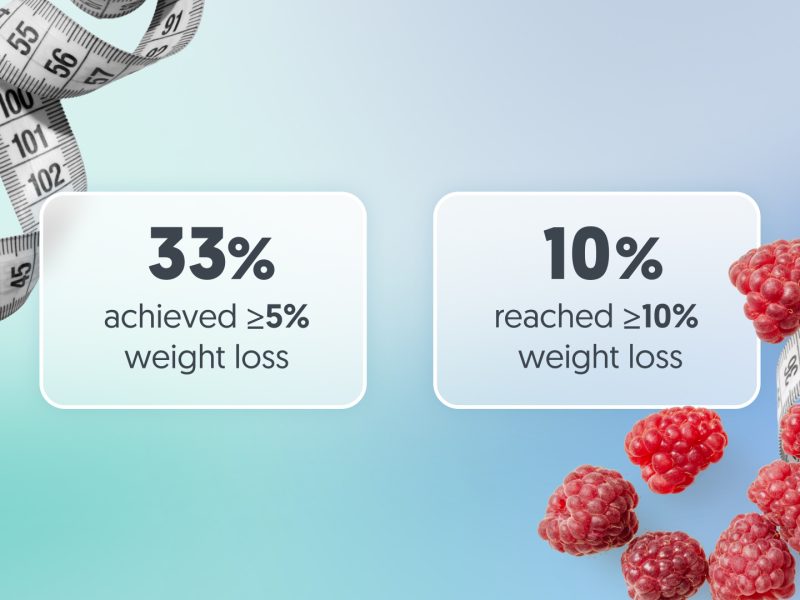
A recent Nutrium Care case study modeled this dynamic across roughly 10,000 employees managing obesity or overweight, and estimated 14% of which had cardiovascular disease. Within six months, 33% of employees with CVD achieved at least 5% weight loss, and 10% achieved more than 10%, working with a Registered Dietitian through 1:1 appointments and ongoing follow-up between sessions rather than a one-time program enrollment.
Applying Nutrium’s program cost against the Thorpe and Joski savings estimates for this population’s weight-loss profile, our model produces an estimated 2:1 ROI within the CVD subgroup specifically, and roughly $3.5 million in modeled gross savings across the broader population of employees with CVD and overweight or obesity combined. These are modeled savings estimates based on observed weight loss outcomes credited only to employees who sustained their results at 12 months, not guaranteed or realized savings, and actual results will vary by population, plan design, and comorbidity profile. Still, the direction is consistent with the wider research: employees managing cardiovascular risk have the most to gain, financially and clinically, from consistent, dietitian-led support.
This is the same logic behind Nutrium Care’s broader model: one comprehensive program covering 20+ clinical specialties, so employees managing cardiovascular risk get the same dietitian-led support as employees working on any other health goal, whether that’s weight management, GI care, or GLP-1 support, without adding another point solution to the benefits stack. The same appointment cadence and proactive follow-up model applies regardless of which specialty an employee needs, which is part of why the outcomes hold up across a mixed-risk population rather than only among the most engaged subgroup.
For most HR teams, the practical question isn’t whether nutrition support can move the needle on cardiovascular cost. The data above says it can. The question is what that would look like applied to your own population, given your specific risk mix, plan design, and current benefits stack. If that’s the calculation you’re trying to run, a Nutrium Care demo walks through how the modeling works for your specific workforce.